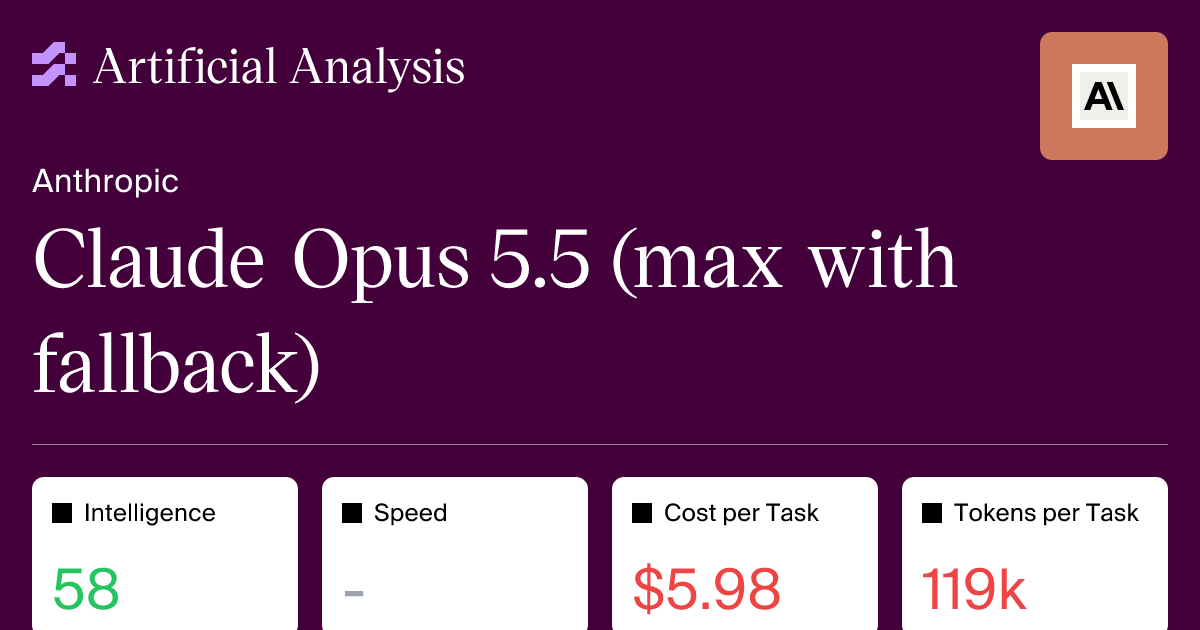
Claude Opus 5.5 Intelligence, Performance and Price Analysis (Max)
CompareTry it out API Provider Benchmarks
以下正文同步自 Hacker News,版权归原站所有,已转换为易读排版。
Artificial AnalysisK
Artificial AnalysisModels
Coding Agents
Image, Speech, Video
Inference
Leaderboards
About
AI Trends
Arenas
K
Anthropic
•Claude Opus 5.5max
•Proprietary model
CompareTry it out API Provider Benchmarks
Model summary
IntelligenceUpdated
#1 / 206
58
Artificial Analysis Intelligence Index
4 out of 4 units for Intelligence.
Speed
N/A
Output tokens per second
Unknown out of 4 units for Speed.
Cost
#87 / 206
In $4.00Out $20.00Cache Discount 95%
$5.98
Cost per Intelligence Index task
4 out of 4 units for Cost.
Verbosity
#89 / 206
260M
Output tokens from Intelligence Index
4 out of 4 units for Verbosity.
Comparison Summary
Claude Opus 5.5 (Adaptive Reasoning, Max Effort, Default Fallback) is amongst the leading models in intelligence, but somewhat expensive when comparing to other models of similar price. The model supports text and image input, outputs text, and has a 1M tokens context window.
Claude Opus 5.5 (Adaptive Reasoning, Max Effort, Default Fallback) scores 58 on the Artificial Analysis Intelligence Index, placing it well above average among comparable models (median: 25). When evaluating the Intelligence Index, it generated 260M tokens, which is very verbose in comparison to the median of 92M.
Pricing for Claude Opus 5.5 (Adaptive Reasoning, Max Effort, Default Fallback) is $4.00 per 1M input tokens (somewhat expensive, median: $2.00) and $20.00 per 1M output tokens (somewhat expensive, median: $10.00). In total, it cost $8708.20 to evaluate Claude Opus 5.5 (Adaptive Reasoning, Max Effort, Default Fallback) on the Intelligence Index.
ReasoningYesThis page shows the reasoning version of this model.
Context window1M~1500 A4 pages of size 12 Arial font
206 models in this class
Metrics are compared against models of the same class:
IntelligenceUpdated
Artificial Analysis Intelligence Index
Artificial Analysis Intelligence Index v4.3.2 incorporates 10 evaluations: AA-Briefcase v1.1, GDPval-AA v2.1, AutomationBench-AA, Terminal-Bench 4.0, SciCode, Humanity's Last Exam, GDP.pdf, CritPt, AA-Omniscience, AA-LCR v1.1
29 of 661 models
Add model from specific provider
Artificial Analysis Intelligence Index
Artificial Analysis Intelligence Index v4.3.2 includes: AA-Briefcase v1.1, GDPval-AA v2.1, AutomationBench-AA, Terminal-Bench 4.0, SciCode, Humanity's Last Exam, GDP.pdf, CritPt, AA-Omniscience, AA-LCR v1.1. See Intelligence Index methodology for further details, including a breakdown of each evaluation and how we run them.
29 of 661 models
Add model from specific provider
ProprietaryOpen WeightsOpen Weights (Commercial Use Restricted)
Artificial Analysis Intelligence Index
Artificial Analysis Intelligence Index v4.3.2 includes: AA-Briefcase v1.1, GDPval-AA v2.1, AutomationBench-AA, Terminal-Bench 4.0, SciCode, Humanity's Last Exam, GDP.pdf, CritPt, AA-Omniscience, AA-LCR v1.1. See Intelligence Index methodology for further details, including a breakdown of each evaluation and how we run them.
Open Weights
Indicates whether the model weights are available. Models are labelled as 'Commercial Use Restricted' if commercial use is limited by conditions, and as 'Non-commercial' if the license prohibits commercial use.
Measures the performance of models on specific capabilities and industries
Incorporates 7 evaluations: AA-Omniscience, GDPval-AA v2.1, AA-Briefcase v1.1, Humanity's Last Exam, AutomationBench-AA, AA-LCR v1.1, GDP.pdf · Higher is better
29 of 158 models
Add model from specific provider
Benchmarks
Intelligence Evaluations
Intelligence evaluations measured independently by Artificial Analysis · Higher is better
CodingAgenticTool UsePrivate DatasetUser InteractionFinanceMedicalLegalIntelligence IndexLong ContextMultimodalInstruction FollowingFaithfulnessWritingBusinessSee more
18 of 26 evaluations29 of 661 models
Add model from specific provider
AA-Briefcase v1.1Updated
Agentic knowledge work, (Elo-500)/2000
GDPval-AA v2.1Updated
Agentic real-world work tasks, (Elo-500)/2000
AutomationBench-AAUpdated
Agentic SaaS workflows
Terminal-Bench 4.0New
Agentic coding & terminal use
Humanity's Last Exam
Reasoning & knowledge
GDP.pdfNew
Professional document reasoning, All-pass
AA-Omniscience Non-Hallucination Rate
1 - hallucination rate
Harvey LAB-AA
Legal agentic work, criterion pass rate
EnterpriseOps-Gym-AA
Agentic business operations
AA-AnalystAgent
Quantitative analysis on spreadsheets & documents
ITBench-AA
Kubernetes incident root-cause analysis
MLCR-AANew
Medical long context reasoning
Intelligence Evaluation Relevance
While model intelligence generally translates across use cases, specific evaluations may be more relevant for certain use cases.
Artificial Analysis Intelligence Index
Artificial Analysis Intelligence Index v4.3.2 includes: AA-Briefcase v1.1, GDPval-AA v2.1, AutomationBench-AA, Terminal-Bench 4.0, SciCode, Humanity's Last Exam, GDP.pdf, CritPt, AA-Omniscience, AA-LCR v1.1. See Intelligence Index methodology for further details, including a breakdown of each evaluation and how we run them.
29 of 179 models
Add model from specific provider
AA-Briefcase Elo
AA-Briefcase Elo is a combined metric that aggregates analytical quality Elo, presentation Elo, and rubric pass rate, with rubric performance converted into Elo via synthetic head-to-head matches. Elo and 95% confidence interval bounds are clamped at 0.
29 of 536 models
Add model from specific provider
AA-Omniscience Index
AA-Omniscience Index (higher is better) measures knowledge reliability and hallucination. It rewards correct answers, penalizes hallucinations, and has no penalty for refusing to answer. Scores range from -100 to 100, where 0 means as many correct as incorrect answers, and negative scores mean more incorrect than correct.
29 of 661 models
Most attractive quadrant
Pareto line
AnthropicXiaomiOpenAISpaceXAIGoogleMetaZ AIDeepSeekAlibaba
Cost per Intelligence Index Task
Weighted average cost per Intelligence Index task. Each evaluation’s cost is calculated from input, cache hit, cache write, reasoning, and answer token prices, divided by task count, and weighted by its Intelligence Index weight.
Artificial Analysis Intelligence Index
Artificial Analysis Intelligence Index v4.3.2 includes: AA-Briefcase v1.1, GDPval-AA v2.1, AutomationBench-AA, Terminal-Bench 4.0, SciCode, Humanity's Last Exam, GDP.pdf, CritPt, AA-Omniscience, AA-LCR v1.1. See Intelligence Index methodology for further details, including a breakdown of each evaluation and how we run them.
29 of 661 models
AnswerReasoning
Output Tokens per Intelligence Index Task
The number of tokens required per Intelligence Index task. This is calculated by multiplying the output tokens per eval by the relative weights of each benchmark in the Intelligence Index, then dividing by task count (excluding repeats).
29 of 661 models
AnswerReasoningCache WriteCache HitInput
Cost per Intelligence Index Task
Weighted average cost per Intelligence Index task. Each evaluation’s cost is calculated from input, cache hit, cache write, reasoning, and answer token prices, divided by task count, and weighted by its Intelligence Index weight.
29 of 661 models
Add model from specific provider
OutputReasoningCache WriteCache ReadNon-Cache Input
Cost to Run Artificial Analysis Intelligence Index
The cost to run the evaluations in the Artificial Analysis Intelligence Index, calculated using the model's input, cache hit, cache write, reasoning, and answer token prices and the number of tokens used across evaluations (excluding repeats).
29 of 661 models
Add model from specific provider
Cache HitInputOutput
Cache Hit
Price per token for cached prompts (previously processed), typically offering a significant discount compared to regular input price, represented as USD per million tokens. The values shown here are the cache hit price; cache write and cache storage are billed separately and vary by provider — see "Cache pricing by provider" for detail.
4 more notes
Context Window
Context WindowIntelligence Index vs. Context Window
Context Window
Context window: tokens limit · Higher is better
29 of 661 models
Add model from specific provider
Context Window for RAG
Larger context windows are relevant to RAG (Retrieval Augmented Generation) LLM workflows which typically involve reasoning and information retrieval of large amounts of data.
Context Window
Maximum number of combined input & output tokens. Output tokens commonly have a significantly lower limit (varied by model).
Common questions about Claude Opus 5.5 (Adaptive Reasoning, Max Effort, Default Fallback)
Claude Opus 5.5 (Adaptive Reasoning, Max Effort, Default Fallback) was released on September 22, 2026.
Claude Opus 5.5 (Adaptive Reasoning, Max Effort, Default Fallback) was created by Anthropic.
Claude Opus 5.5 (Adaptive Reasoning, Max Effort, Default Fallback) scores 58 on the Artificial Analysis Intelligence Index, placing it well above average among other reasoning models in a similar price tier (median: 25).
Claude Opus 5.5 (Adaptive Reasoning, Max Effort, Default Fallback) costs $4.00 per 1M input tokens (somewhat higher than average, median: $2.00) and $20.00 per 1M output tokens (somewhat higher than average, median: $10.00), based on Anthropic's API.
Claude Opus 5.5 (Adaptive Reasoning, Max Effort, Default Fallback) costs $4.00 per 1M input tokens and $20.00 per 1M output tokens (based on Anthropic's API). For a blended rate (7:2:1 cache hit/input/output ratio), this is $2.94 per 1M tokens. Pricing may vary by provider. Compare provider pricing
When evaluated on the Intelligence Index, Claude Opus 5.5 (Adaptive Reasoning, Max Effort, Default Fallback) generated 260M output tokens, which is at the higher end compared to other reasoning models in a similar price tier (median: 92M).
Yes, Claude Opus 5.5 (Adaptive Reasoning, Max Effort, Default Fallback) is a reasoning model. It uses extended thinking or chain-of-thought reasoning to work through complex problems before providing an answer.
Claude Opus 5.5 (Adaptive Reasoning, Max Effort, Default Fallback) supports text and image input.
Claude Opus 5.5 (Adaptive Reasoning, Max Effort, Default Fallback) supports text output.
Yes, Claude Opus 5.5 (Adaptive Reasoning, Max Effort, Default Fallback) supports image input and can analyze, describe, and answer questions about images.
Yes, Claude Opus 5.5 (Adaptive Reasoning, Max Effort, Default Fallback) is multimodal. It can process text and image input and generate text output.
Claude Opus 5.5 (Adaptive Reasoning, Max Effort, Default Fallback) has a context window of 1.0M tokens. This determines how much text and conversation history the model can process in a single request.
No, Claude Opus 5.5 (Adaptive Reasoning, Max Effort, Default Fallback) is proprietary. The model weights are not publicly available.
Claude Opus 5.5 (Adaptive Reasoning, Max Effort, Default Fallback) is a proprietary model and Anthropic has not disclosed the model size or parameter count.
Claude Opus 5.5 (Adaptive Reasoning, Max Effort, Default Fallback) achieves a score of 58 on the Artificial Analysis Intelligence Index. This composite benchmark evaluates models across reasoning, knowledge, mathematics, and coding.
Yes, Claude Opus 5.5 (Adaptive Reasoning, Max Effort, Default Fallback) is available via API through 1 provider. Compare API providers
Claude Opus 5.5 (Adaptive Reasoning, Max Effort, Default Fallback) is available through 1 API provider. Compare providers
XLinkedInYouTubeRednoteDiscord
© 2026 Artificial Analysis
正文由 FLUX 从来源站点 RSS 同步,内容未经改写;遇到排版缺失或需要图片、视频时请以原文为准。