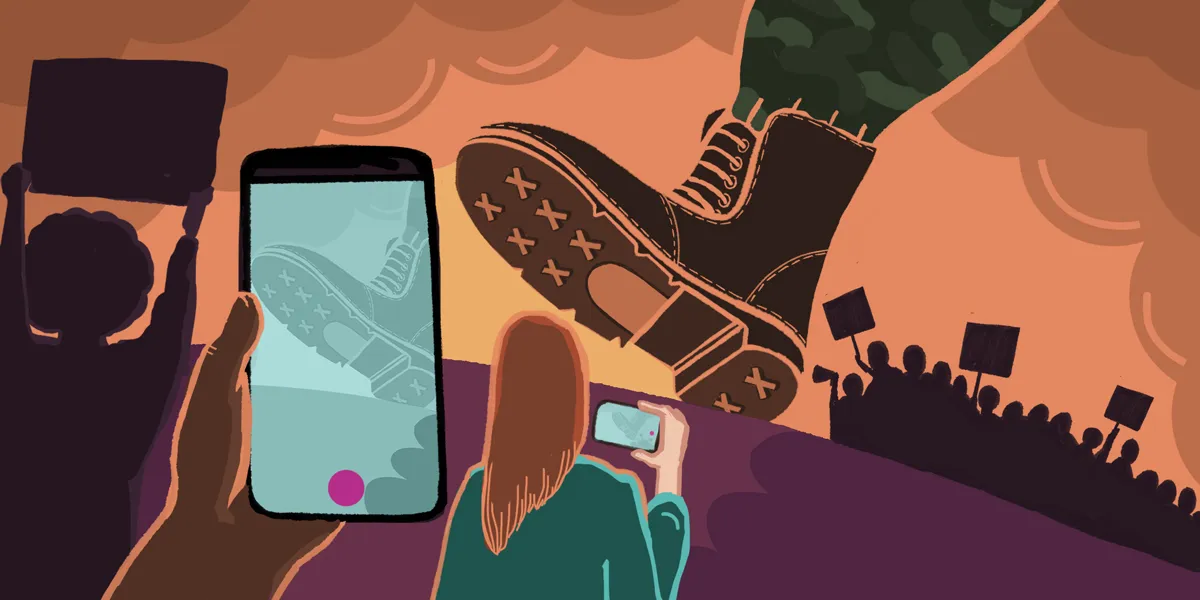
Vacate a Drone Restriction That Criminalized Recording Immigration Agents
EFF joined an amicus brief with ACLU, ACLU of D.C., National Press Photographers Association, and Professional Photographers of America to urge the D.C. Circuit to vacate an FAA drone flight restriction that violated th…
以下正文同步自 Hacker News,版权归原站所有,已转换为易读排版。
EFF joined an amicus brief with ACLU, ACLU of D.C., National Press Photographers Association, and Professional Photographers of America to urge the D.C. Circuit to vacate an FAA drone flight restriction that violated the First Amendment right to record law enforcement. This is an important case—Levine v. FAA—challenging the ability of the government to punish drone pilots who record law enforcement officers engaged in official business.
As we wrote about earlier this year, the FAA issued a flight restriction for drones that had effectively criminalized the recording of Department of Homeland Security officers, including immigration agents from ICE and CBP, and their vehicles (what the FAA called “mobile assets” including “ground vehicle convoys and their associated escorts”) even if the drone was over half a mile away.
A drone operator, represented by the Reporters Committee for Freedom of the Press, sued the FAA in March [PDF]. But in April, the FAA rescinded the flight restriction.
The petitioner argued in his opening brief that the court should evaluate the legality of the flight restriction even though it was withdrawn. Drone pilots could still be punished for violations that occurred when the flight restriction was in effect. And the FAA could reinstate the flight restriction at any time, given that the rescission did not seem to reflect “a true change of heart” but rather an effort by the agency to avoid judicial review.
The amicus brief, filed in support of the petitioner, noted that drones are unique because they provide “perspectives that cannot be captured by ground-based imagery,” and they “are far more maneuverable than ground-level cameras, and they are both much cheaper and much safer than using a chartered plane or helicopter to record newsworthy events from above.” The brief highlighted that drones have captured “bird’s-eye images of protest activity” and “police uses of force against protestors,” and have “allowed journalists to provide the public with up-to-the-minute information about natural disasters without putting themselves in harm’s way.”
The brief argued that using drones to capture images and video is information-gathering activity protected by the First Amendment (similar to using cell phones to record law enforcement). The brief also argued that the FAA’s flight restriction appeared to be issued specifically to ban the recording of immigration agents and thus hinder accountability for their enforcement actions—it surely wasn’t a coincidence that the FAA imposed “no-drone zones around all roving DHS patrols just as those patrols were provoking intense national backlash.” If that’s true, it would make the FAA’s action a content-based restriction on speech that is subject to strict scrutiny—the highest First Amendment standard—and presumptively unconstitutional. And even under less rigorous standards of First Amendment scrutiny, the flight restriction is unconstitutional because the FAA can’t articulate any valid governmental interest justifying such a sweeping restriction on speech.
Resolving this issue to protect First Amendment rights is especially urgent as government agencies continue to sink billions of dollars into technology designed to counter drones—technology that could easily be deployed against journalists and other people hoping to use drones to document government abuse.
We urge the D.C. Circuit to review the petition and to vacate the FAA’s flight restriction, which would send a message that the government can’t avoid accountability by punishing those who exercise their First Amendment rights.
正文由 FLUX 从来源站点 RSS 同步,内容未经改写;遇到排版缺失或需要图片、视频时请以原文为准。