NVIDIA Isaac ROS 5.0 Advances Agentic, Open Source Robotics Development
To build and deploy sophisticated robotics applications that can perceive, reason and act in dynamic environments, developers need new physical AI models and tools. The ROS open framework is a project from Open Robotics…
以下正文同步自 NVIDIA Blog,版权归原站所有,已转换为易读排版。
To build and deploy sophisticated robotics applications that can perceive, reason and act in dynamic environments, developers need new physical AI models and tools.
The ROS open framework is a project from Open Robotics that helps humans build robots. NVIDIA Isaac ROS 5.0 — a collection of GPU-accelerated packages built on ROS, released today at the ROSCon conference in Toronto, Canada — helps humans and AI agents build robots together.
The release introduces new agentic workflows and platform support to help developers build, customize and deploy robotics applications faster.
ROS provides the open source foundation for much of modern robotics development, giving developers common tools, libraries and standards for building and connecting robot applications.
NVIDIA Isaac ROS brings NVIDIA accelerated computing, physical AI models and production-ready libraries to the nearly 1.3 million ROS users, helping developers build high-performance robotics applications using free, familiar, open source tools.
Bringing AI Agents Into Robotics Development
AI agents are changing how software is built, helping developers automate repetitive tasks, navigate complex codebases and move from ideas to working applications faster. Isaac ROS 5.0 brings these capabilities to robotics development.
Isaac ROS 5.0 introduces support for ROS Lyrical and Ubuntu 24.04, giving developers a path to adopt the latest ROS platform while continuing to accelerate demanding robotics workloads with NVIDIA accelerated computing. NVIDIA worked with the Open Source Robotics Alliance to contribute a standard data-handling interface to ROS Lyrical that helps robotics software work efficiently across different computing hardware, including GPUs.
Available to the entire ROS community, it gives developers a consistent way to accelerate demanding robotics applications, with CUDA providing a working example for GPU acceleration.
New NVIDIA Isaac skills for setup and manipulation provide reusable workflows that developers and AI agents can use to complete robotics development tasks. Agent-ready documentation also makes it easier for AI agents to understand Isaac ROS tools and workflows, turning developer intent into working applications faster.
Some skills go beyond assisting with individual coding tasks. A new FoundationStereo fine-tuning skill enables an AI agent to help adapt a stereo perception model to a developer’s cameras, environment and robotics application, so developers can easily achieve more accurate perception for a given sensor configuration.
FoundationPose, a foundation model for object pose estimation and tracking, now provides an agent-ready inference library that enables robots to perceive and track the position and orientation of objects up to 5.5x faster.
In addition, pick and place — a common workflow that connects detection, depth estimation and pose output — is now available as a standalone, agent-ready skill, providing robot developers more flexibility beyond Isaac ROS.
Accelerating the Open Source Robotics Ecosystem
The robotics ecosystem is already extending this agentic approach to development workflows.
AgenticROS, an open source project sponsored by 3D perception technology company RealSense, connects Isaac ROS with NVIDIA Nemotron open models and NVIDIA NemoClaw blueprints, enabling AI agents to interact with ROS-based robots. RealSense is also optimizing its latest AI-native 3D stereo depth cameras, including RealSense D585 Pro, and an open source software development kit for Isaac ROS and the NVIDIA Jetson Thor edge AI platform, helping developers build perception, navigation and manipulation applications.
Intrinsic’s Open Machine Tending Solution is a reference application for computer numerical control machine tending, part of the newly released Intrinsic Core, an open source suite of preconfigured runtime services and capabilities designed to accelerate industrial robotics applications. It includes built-in compatibility with NVIDIA FoundationPose for out-of-the-box object registration, tracking and pose estimation. Using the FoundationPose perception pipeline, the solution enables robots to dynamically detect and handle parts while reducing the need for rigid, costly physical fixtures and specialized systems integration.
Intrinsic uses FoundationPose to perform seamless object perception in its Open Machine Tending Solution.
Seeed Studio is using NVIDIA Isaac ROS with reBot Arm, combining accelerated perception, spatial understanding and motion planning on NVIDIA Jetson Thor. This integration gives developers a practical platform for building adaptable physical AI applications, from object localization to collision-aware manipulation and autonomous pick and place.
Magna is using NVIDIA Isaac ROS as a modular, GPU-accelerated foundation for robotic perception, synchronized data collection and NVIDIA Isaac GR00T model deployment, pairing it with Isaac Sim hardware-in-the-loop testing to bring intelligent automation from research to real-world manufacturing and mobility — faster and with fewer risks.
Magna pairs Isaac ROS with Isaac Sim for hardware-in-the-loop testing for faster deployment.
Prefix.dev’s Pixi package-management tool makes it easier to create reproducible robot development environments, bringing together ROS with the NVIDIA CUDA platform to help developers more easily set up and share accelerated robotics workflows.
As an Isaac ROS Partner, Foxglove helps developers visualize and debug live ROS applications through its web and desktop tools, which are integrated throughout Isaac ROS tutorials and support data such as 3D topics, nvblox meshes and rosbags.
Flexiv is integrating Isaac ROS with its Rizon 4 adaptive robot, giving developers access to NVIDIA-accelerated robotics capabilities and a streamlined path from testing applications in NVIDIA Isaac Sim to deploying them on a physical robot.
A Flexiv robot developed with Isaac ROS and Isaac Sim deployed as a welding arm in a car factory.
Ekumen, a Grid Dynamics Company, is using GPU-accelerated Isaac ROS packages within existing ROS and Nav2 stacks to improve precision docking, 3D obstacle detection, visual localization and real-time motion planning, validating each application in Isaac Sim.
Ekumen uses isaac_ros_cumotion on a GPU to map a collision-free path for a warehouse arm in roughly 2 to 5 milliseconds.
Ouster integrates its Stereolabs ZED stereo cameras with NVIDIA Isaac ROS to deliver GPU-accelerated perception for robotics applications. The integration simplifies the development of real-time object detection, mapping and navigation while maintaining interoperability with the broader ROS ecosystem.
Bringing the Complete Physical AI Stack to the Robot
The applications that developers and agents build ultimately need to run on the robot.
NVIDIA Jetson is a scalable computing platform for running the physical AI stack at the edge with real-time performance, bringing together ROS, accelerated perception and navigation, AI models and application logic on the robot.
Isaac ROS 5.0 supports scalable compute, from entry-level NVIDIA Jetson Orin Nano to high-performance Jetson Thor devices, giving developers a path from development to deployment as robotics workloads become increasingly sophisticated.
Robotics companies are already using this combination to bring more AI processing directly onto their machines.
Mentee Robotics uses NVIDIA Isaac ROS as the perception and AI backbone of its MenteeBot humanoid, enabling the robot to interpret visual information and execute learned behaviors in real time. A shared software foundation across NVIDIA Jetson Orin and Jetson Thor platforms helps Mentee extend its innovations from existing robots to next-generation systems.
The MenteeBot humanoid robot uses Isaac ROS to scale its perception capabilities across Jetson hardware platforms.
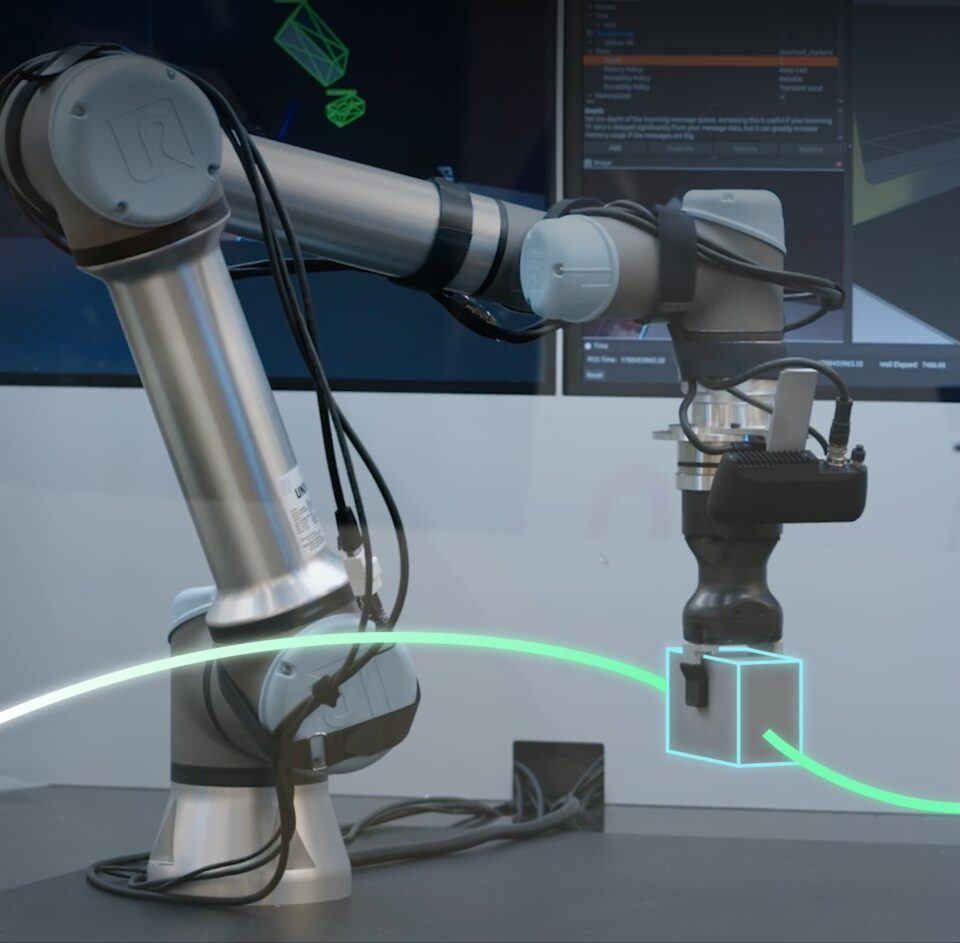
Universal Robots has built NVIDIA Isaac ROS into its AI Accelerator software development kit to help integrators deploy advanced perception and motion capabilities faster, without developing complex robotics software from scratch. Powered by NVIDIA Jetson at the edge, the solution enables robots to adapt to parts that are not precisely positioned, reducing reliance on costly fixtures and making manufacturing cells more flexible.
ROBOTIS, which builds the developer-friendly ROS-based TurtleBot3, is integrating Isaac ROS into its AI Worker robot, using GPU-accelerated object perception to enable vision-guided manipulation tasks including picking, placing and alignment.
ROBOTIS performs object manipulation tasks using NVIDIA Isaac ROS CuMotion.
FieldAI’s robot foundation models, which can run entirely on robots without relying on cloud connectivity, are integrating Isaac ROS on Jetson devices to take greater advantage of GPU acceleration and improve the efficiency of the on-robot AI stack.
Noble Machines is using NVIDIA Isaac ROS on Jetson to accelerate the development of general-purpose robots for industrial applications, building on ready-to-use AI and perception capabilities rather than creating them from scratch.
By combining an open robotics ecosystem, accelerated computing and new agentic development workflows, Isaac ROS 5.0 helps developers address both sides of the physical AI challenge: building increasingly capable robot applications and efficiently running them in the physical world.
Available now, Isaac ROS 5.0 is free and open source. Developers can learn more and get started with NVIDIA Isaac ROS on GitHub.
正文由 FLUX 从来源站点 RSS 同步,内容未经改写;遇到排版缺失或需要图片、视频时请以原文为准。